

In recent weeks we have been visiting the New York State Museum in Albany. It’s something that all we New Yorkers can and should be proud of. It houses a vast and fine collection of biological, archaeological, historical and geological specimens. It has long employed large numbers of world-renowned scholars. But we have been there for three weeks now, and we haven’t even passed through the doors! We’ve been stuck outside wandering along the walls and gazing at their building stones. Gazing -transfixed, engrossed, gripped, fascinated, and even spellbound and mesmerized. (The humor is in the understatement!) That was, no doubt, the intention of the architect who designed the building. He wanted us to do just exactly that.
Indeed, we did just that and found ourselves transported into the distant New York State past – it’s geological past – in fact, several of them. Two weeks ago, we found ourselves at the bottom of a steep submarine slope, looking up at advancing deepwater avalanches. Billowing masses of dirty water approached us at 50 miles per hour and passed through and across us. Last week we stood along the bank of a 385-million-year- old river and watched as waves washed ashore. Both these events came to be hardened into rock and then cut into the stone that makes up the outer walls of today’s museum.

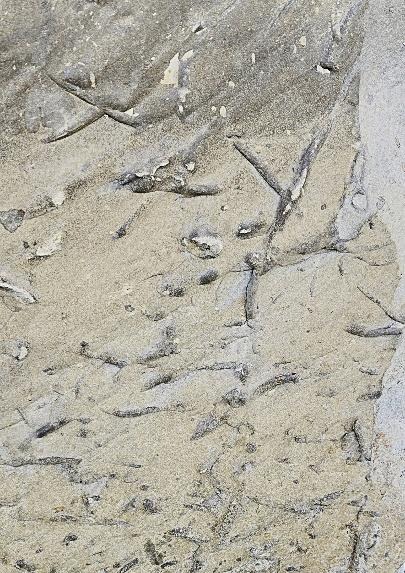
Take a look at this week’s photo. It shows another moment in time. It’s one of many building stones that display more of what geologists call primary structures. These are biological structures, some categories of once living creatures made them. What kind of animals were they? We don’t know and it’s not likely that we will ever find out. Chances are that these were invertebrate animals, but that doesn’t help much, does it? Most paleontologists just shrug their shoulders and say “worm.” They usually go on to say “worm burrow.” In today’s world the sea floors display large numbers of worms that burrow through the sediments and produce similar structures. Knowing this we look at and see about 20 ancient worms digging through the muds that once made up this sea floor. We go on to guess that each was looking for something to eat. But that is nothing more than an informed guess; we are scientists and wish that we could do better. These are creepy crawlers and all we can be sure of is that this was creepy crawling.
But there is something else. Take one more look at our picture. That’s a photo of an ancient sea floor. When we stand before something like this it is instinctive for us to reach out and touch it. We are literally touching a 450-million-year-old sea bottom. Then our fingers go from one burrow to another and then another. We are touching the very spaces that were occupied by these animals so long ago. We can share space with them but never their time. It’s an odd thing; we can practice this form of time travel, but we never actually get to those moments.
Our visit to the State Museum’s outside has been most rewarding but there are better things inside. That includes a good place to get lunch; we will surely eat a lot better than those worms did!
Contact the authors at randjtitus@prodigy.net. Join their facebook page “The Catskill Geologist.” Read their blogs at “thecatskillgeologist.com.”