

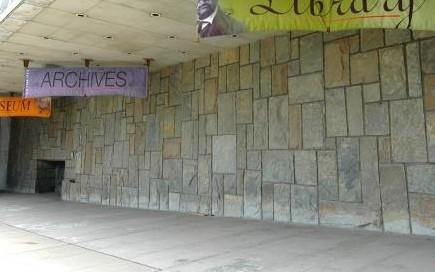
You’re bound to visit the New York State Museum in Albany someday, maybe soon. We have visited it many times and there is so much to see there. But, today, let’s not rush inside; let’s walk slowly along the outside walls. They display a wide number of attractive sandstone slabs. See our first photo. The museum’s architect wanted to create walls that were not only visually pleasing but also scientifically appropriate. But you need to know a little about them to appreciate this. Let’s start today.

Take a look at our second photo. That’s a close-up view of one sandstone slab on the museum wall and it shows some remarkable features. These are what geologists call sedimentary structures; they were implanted onto those sediments at the moment of their deposition on the floor of the ocean, back when they were still soft, in this case deposits of wet sand. This one was from the Ithaca Formation, a unit of rock found off a little to the west of the Catskills. That means they did indeed come from the offshore margin of the ancient Devonian aged Catskill Delta.

There are two broad categories of sedimentary structures - physical and biological. The biological ones were mostly the products of the activities of animals who lived on the ancient sea floor. Physical structures are all the others. Both waves and currents can produce a variety of such structures, but this is something special. Virtually all geologists, anywhere in the world, would quickly recognize those features as being what are called “flute casts” they have quite a story to tell.
We first guessed that this slab of sandstone was once at the bottom of a very deep sea. It was something that we call a marine trench, and the Marianas Deep, in the western Pacific, is a terrific example of a modern one. That trench is about 36,000 feet deep. It had steep slopes, and the sand was only partially stable. Geologists debate the details, but the story that the two of us like is that there was a nearby mountain building event going on and an earthquake struck. That threw up large amounts of sediment into dense masses of cloudy water. Those, slowly at first, started moving downslope. Then they speeded up and the whole mass became a powerful force. These have been seen today, and they are called turbidity currents.
As the flow continued down into the depths of the trench, they scoured into the sand below and carved out the patterns we see on this slab. In this case the flow was from the upper right to the lower left. As the flow passed by it started to slow down and its sand was deposited to fill up each of the cavities to create the flutes. The downstream end of each scour is quite steep.
But here’s the problem with that hypotheses: there were never any deep trenches in that part of the state, so we asked around. We were referred to a peer-reviewed article about the Ithaca Formation. It turns out that these sediments were deposited offshore of the Catskill Delta. If you are one of our long-term readers, then you know that the Catskills are essentially a petrified delta – the Catskill Delta. Those flutes formed when turbidity currents flowed down the delta’s offshore slope.
Those flutes make for a picturesque image and hence the architect picked out this and many other similar slabs to festoon the Museum wall. We geologists are such privileged people. So often we gaze not just at but into a rock and see such remarkable things. That has certainly been the story today, but this story is not over yet. Please come back next week. There are a lot more stones at the museum.
Contact the authors at randjtitus@prodigy.net. Join their facebook page “The Catskill Geologist.” Read their blogs at “thecatskillgeologist.com.”