

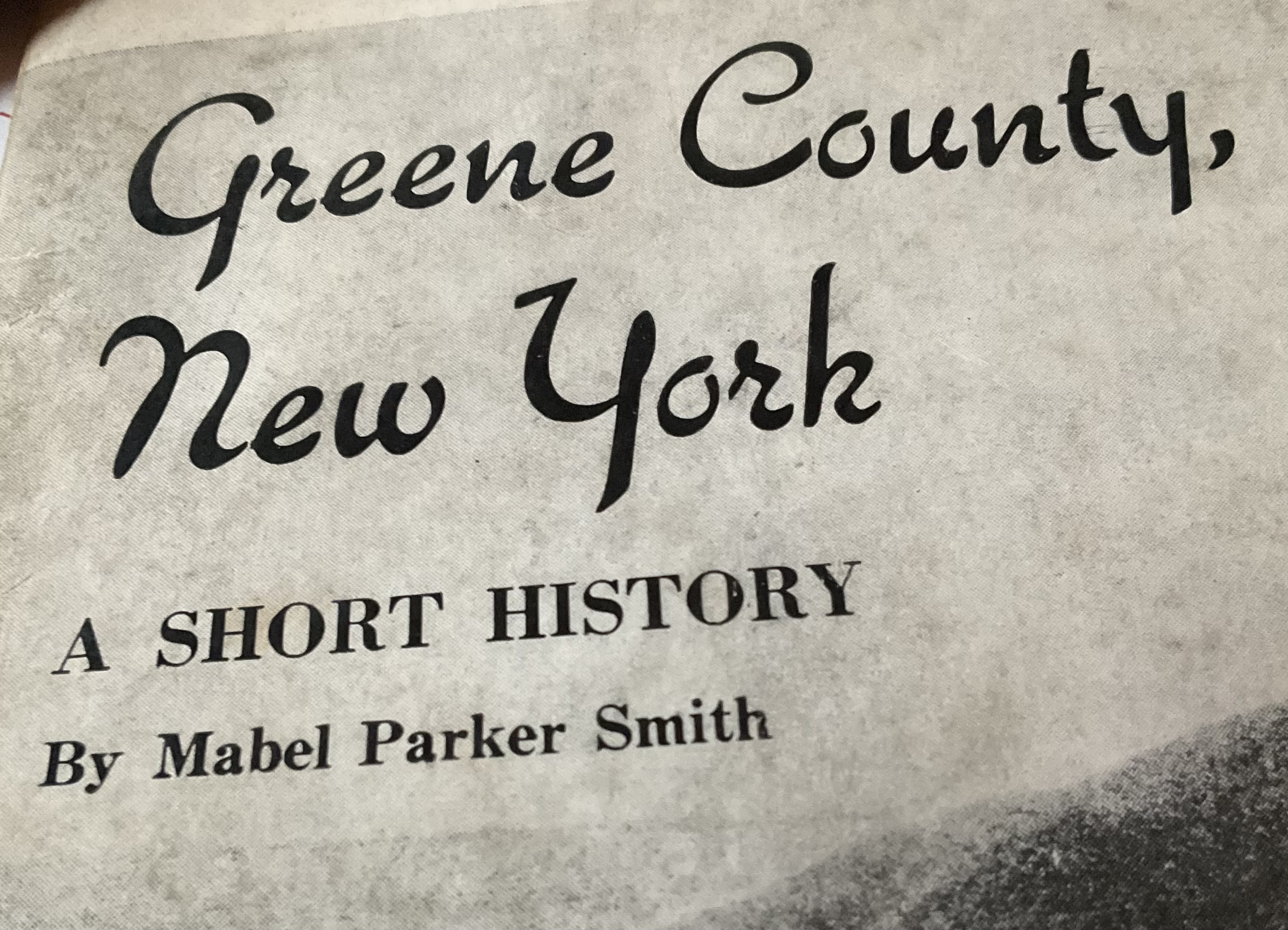
Mabel Parker Smith must have been quite the lady and quite the historian. In her short 18-page history of Greene County, she managed to cover much since its inception in 1800.
Parker-Smith said, “Greene County’s industrial history begins with one of the most remarkable archeological monuments known to this continent: the vast Indian quarries along Flint Mine Hill, south of Coxsackie, explored by State Archeologist Dr. Arthur C. Parker in the 1920s. On the findings of Dr. Parker these mines are said to have been worked for as much as 12,000 years before the coming of the white man. The mining tract of about forty acres was purchased in 1961 by the Long Island chapter of New York State Archeological Association to assure its preservation.”
She also said that a few of the industries of Greene County included a variety of mills: grist , flour, woolen, and cotton, fishing and ice harvesting, tanneries (until the forests were nude of hemlocks), fruit-growing, sheep and cattle-raising, dairy, brick manufacture (Catskill and Athens), and then on to the Portland Cement industry concentrated at Cementon, at the lower tip of Greene County.
We had chair factories, cabinet makers, foundries at Catskill, Athens (Clark Pottery for over 100 years), Coxsackie, and Oak Hill. This only touches on the various jobs in the county.
Today, she said, we have farming and dairying (but much less), poultry and mushroom plants, the prison, and the new winter sports (Windham Mountain, first known as Cave Mtn., opened in 1950 with Hunter in 1959-1960).
Mable Parker Smith in ending her book said that Greene County remains a rural county, “a goodly heritage” still to those fortunate enough to call the regions home and, as it has been for years, a convenient refuge and playground for those who would escape, “the plagues and fevers of city life.”
Thank-you Mabel Parker Smith, we are fortunate to live here! Please stay safe and be well.
Dede Terns-Thorpe/Hunterhistorian@gmailcom.
