

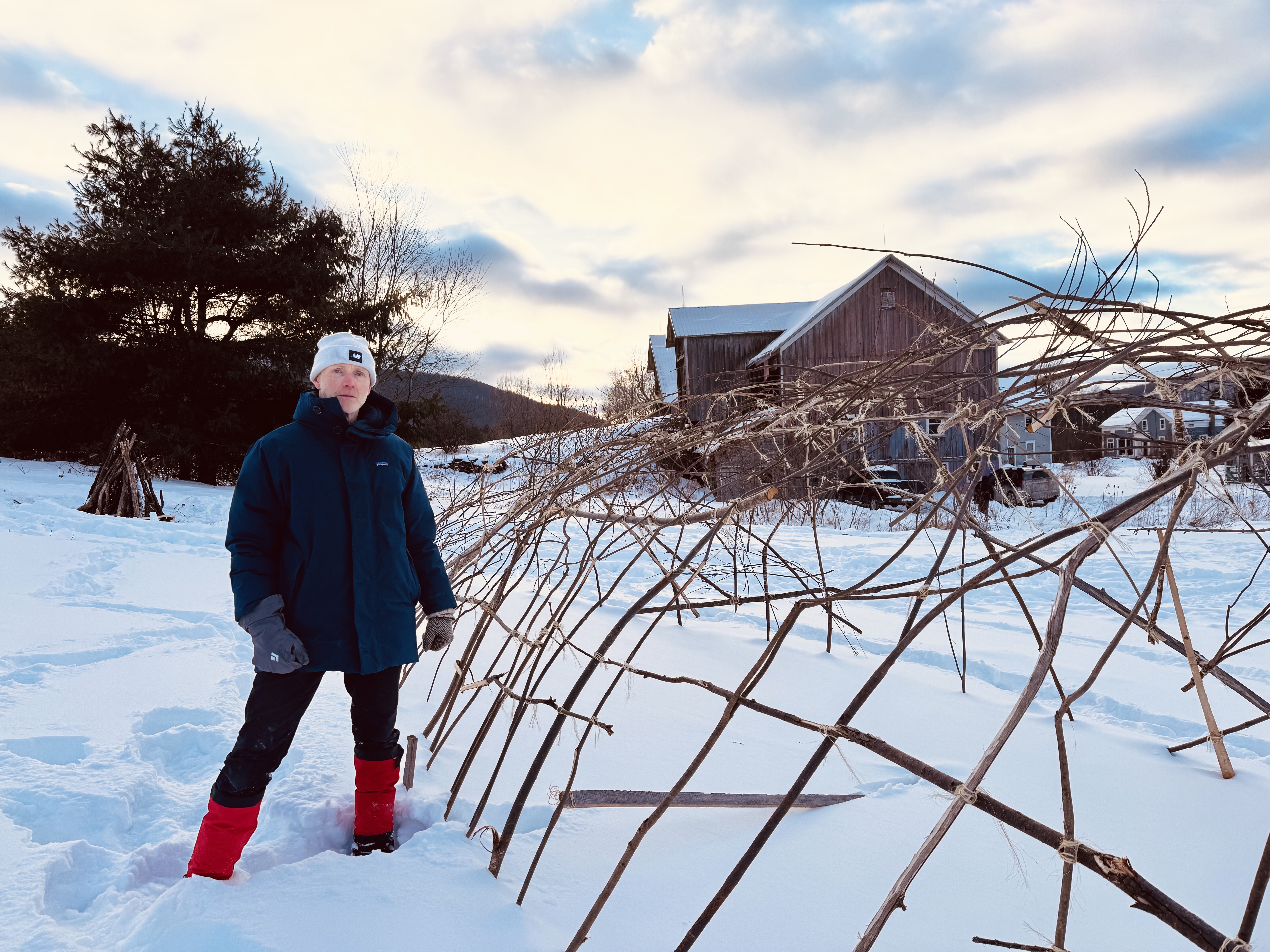
Above photo: Artist John Atwood memorializes the memory of friends lost with a sculpture at the Turquoise Barn in Bloomville
BLOOMVILLE — In a snow-covered field at the foothills of the Catskills, with temperatures hovering in the single digits, nearly 50 people gathered on Sunday evening, Feb. 1, for an art ceremony that asked for endurance, attention, and emotional openness in equal measure. The event, titled Field Mountains, was conceived by artist and sculptor John Atwood as a memorial honoring friends lost too soon.
The ceremony unfolded at Torques Barn, a historic structure built in the 1700s and owned by artist and venue host Michael Milton. While the barn provided shelter from the wind, it offered little relief from the cold. Breath hung visibly in the air as attendees bundled in winter coats and hats, an element that quietly shaped the tone of the evening. This was not a passive gathering. It required commitment simply to be present.
Two of Atwood’s close friends had passed away unexpectedly over the past year, along with a shared friend named Cole. Rather than framing the event solely as a private memorial, Atwood opened the ceremony to the wider community, inviting those in attendance to also honor loved ones they had lost. From the outset, the gathering carried a collective spirit, grounded in shared experience rather than formal ritual.
Before the performances began, Atwood spoke about the art installation constructed in the snow-covered field just beyond the barn. Two large structures made of sticks and twine rose from the landscape, later in the evening illuminated by torches as night fell. Atwood described them as suggestive of Viking ships or burial mounds, forms that evoke passage, shelter, and the movement between worlds.
The installation itself was built with help from students at the Bovina Montessori School, an element Atwood emphasized as central to the project’s meaning. He explained that shelter building is part of the school’s curriculum, and the children’s participation connected learning, creativity, and community engagement. The experience was shared in a way that felt heartfelt rather than instructional, underscoring Atwood’s desire for the work to be something created with others rather than simply presented to them.
That emphasis on participation extended into the ceremony itself. Attendees moved between the barn and the field, gathered around fire, listened closely, and stood together in the cold. Atwood later reflected that events like this remain vital, particularly in a time when creative communities are often described as diminished or fragmented. He noted that while conversations often look back nostalgically to the energy of the 1980s art and music scenes, what truly sustains culture is not nostalgia but intention, commitment, participation, and vision.
One of the most striking moments of the evening came through the presence of children, particularly four-year-old Ivo, whose wonder became an unexpected emotional counterpoint to the themes of death and loss. Atwood described holding Ivo’s hand as they walked from the barn to the sculptures, watching as the child’s amazement grew at the sight of torches and towering forms glowing against the snow. Ivo crawled through the openings in the structures, explored their interiors, and returned with a dried goldenrod head, which he presented to Atwood as an award for “best guy.” For Atwood, this interaction embodied the cycle of life in a tangible way, the energy of youth standing alongside remembrance, each giving shape to the other.
The evening also carried a sense of rare alignment. Though the date was chosen primarily around musician Brian Crabtree’s availability, Feb. 1 coincided with Imbolc, an ancient Irish festival marking seasonal transition, as well as a full moon. The moon appeared intermittently through shifting clouds, adding to the atmosphere of quiet intensity. For those gathered, these coincidences deepened the sense that the event was occurring within a larger rhythm, one that extended beyond individual intention.
Music played a crucial role in shaping the ceremony’s emotional arc. Brian Crabtree’s ambient soundscape filled the barn and field with tones that felt both expansive and grounding. Michael Crabtree’s contributions leaned toward the hymnal, with sounds reminiscent of ocean waves that eventually settled into a steady, calming presence. As people shook off the chill inside the barn, the music offered warmth of a different kind, something internal and steady.
Poet Alana Siegel’s reading formed the emotional core of the ceremony. Her poem lasted more than twenty minutes, holding the room in sustained attention. At one point, Siegel offered a passage that lingered in the air long after it was spoken:
“Water is best and golden like a blazing fire in the night. I saw a rhythm in the form of a knot, I saw music held above me in the form of collage, in the palm of my hand, a Christmas tree, me, a botanical wanderer, confused by pilgrimage, the leader of their sect is forgetting their mother, more so denying her power, I sit in careful secret, in the sailor's stitch, growing tighter, the further we are from each other.”
Siegel’s words moved fluidly between image and emotion, capturing recalled moments with a raw immediacy that drew listeners in line by line. Her delivery balanced humor and heartache, creating space for both recognition and mourning. Throughout the reading, her tone carried an urgency that pressed against distraction, asking the audience to listen deeply and remain present, even as the cold seeped into the room and breath continued to billow visibly around them.
The barn, chilled and dimly lit, became a place of focused stillness. Siegel’s language grounded the gathering in something elemental, reinforcing the idea that meaning often lies beyond what is obvious or routinely narrated. Her imagery of seeds scattered beneath trees, of hidden beauty and overlooked terrain, resonated strongly in that setting, where nature, art, and human vulnerability were inseparable.
Atwood later reflected on the physical hardship of the evening as an essential component rather than an obstacle. He spoke about the necessity, in many past cultures, of performing rituals and how stepping into difficulty can heighten the significance of what is being honored. “The magic and spirituality of the ceremony matches that of the way I interact with the landscape and hills around here and just felt incredibly fitting,” Atwood said.
That sense of shared endurance was softened by simple acts of hospitality. Mulled wine, prepared in generous quantity, and a bottle of bourbon offered warmth and comfort, drawing people together in small circles of conversation. The spices and citrus of the drink felt timeless, a small but meaningful gesture connecting the present moment to traditions of communal care.
As the evening came to a close, the sculptures continued to glow in the field, their forms steady against snow and darkness. The event left many with the feeling that something rare had occurred, not because of spectacle, but because of sincerity. The crossed paths of people who come into our lives and change us, sometimes in profound ways, were acknowledged and honored.
Field Mountains, through Atwood’s installation and the layered contributions of music and poetry, created a pause in time. It invited reflection on those lost, while gently opening space to better appreciate those still present. In that cold barn and illuminated field, the space between the living and the departed felt briefly alive, held together by intention, memory, and shared experience.

Brian Crabtree swept the participants away with his ambient mix creating a somber and reflective tone throughout the Turquoise Barn

Poet Alana Siegel captures the mood with her magnificent delivery of her contribution to the Field Mountains event.

The participants were invited to write the names of their loved ones departed on paper to add to the bonfire ceremony at the conclusion of the evening this past Sunday