

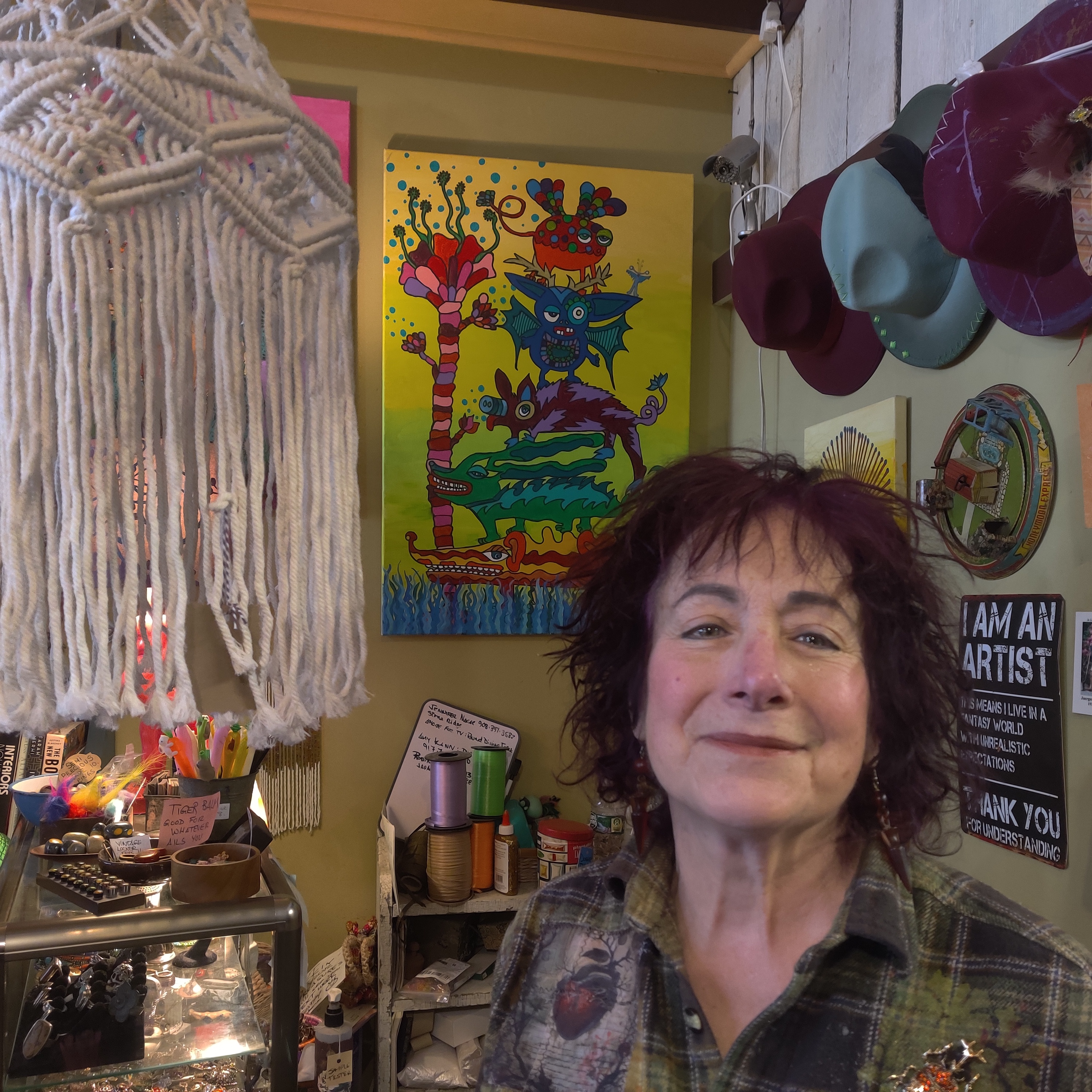
Story and Photos by Lorcan Otway
MARGARETVILLE — It is noon on Margaretville's Main Street and there is a steady flow of customers and browsers at Barbara's Alyn’s unique shop. A young woman, a local and regular visitor asks after the "Fox" that she saw last time she was in the shop. Barbara's face falls. "I love to pet it." she says "It is five fifty. The visitor thinks for a moment, "Five fifty...what?" Barbara replies, "Five hundred and fifty dollars."
The woman nods. You can see she is wrestling with her want of the treasure. "I hate to sell it,"
Barbara continues. My husband says I can pet our two dogs,they're alive. If I have a shop I have to sell things." The young woman looks slightly confused and points to a glass case on Barbara's desk. "Five hundred and fifty? Barbara sounds relieved. "OH! You mean the necklace? Oh no, that's sixty!" I bet you thought it was rare gems or something when I said five fifty. I meant the fox in the back.? "I was considering it," the customer says, her dilemma satisfied and happy.
More people come in the shop, Barbara repeats the opening refrain in her greeting to new arrivals. "Have you been here before? Sock room in the back, it curves to the right, The room on the left..." It is wise to start with that, there is so much to discover, an opening guide is an invitation to explore.
Since the early cave dwelling Stone Age humans transformed the rock wall of the caves into herds of animals at places like Lascaux , art has been about transformation. As humans began to create settlements, shops have been selling commodities. Barbara Alyn's shop on Main Street, Margaretville is a place which weds these concepts together. The shop is a work of art. It is a place when objects are in a state of metamorphosis, while the shop's environment is in a state of artistic emergence at the same time. As people enter the shop, Barbara becomes a guide to the world she is in the process of creating.
"Hello, have you guys been here before?" Some people say yes or no, some people, flatlanders perhaps, are not used to being greeted and spoken to as they enter a shop, then immediately look down at what they assume are the commodities which will reveal to them the nature of the shop. This does not deter Barabara for an instant. "Welcome, my name's Barbara, I make and remake quite a few things in here," She points to the back of the shop, "Sock room, walk through to the big room with the vintage furniture, home goods, taxidermy, all kinds of stuff lives that way. Any questions I can answer."
There are hats in the big room. However, "hats" does not begin to give a clue to the pieces of art on one of the back room tables, They are felt top hats, hats of different shapes, covered with beads and silks with swirling designs, feathers, and flowers. Brightly painted fedoras and fascinators. There are functional winter hats, also displaying the bright changes worked on them by Barbara's ever creating hands. I recall the Joni Mitchel song, "Ladies of the Canyon."
Trina wears her wampum beads
She fills her drawing book with lines
Sewing lace on widow's weeds
And filigree on leaf and vine
Vine and leaf are filigree
And her coat's a second-hand one
Trimmed with antique luxury
She is a Lady of the Canyon
Antique luxury. She takes shears to Pendleton blankets and converts them into expertly made Pendleton/Alyn wonderful Native themed, hooded winter coats. The clothing is a journey of discovery. A customer asks about an Asian shirt. It is pre-war clothing from Okinawa. The craftsmanship in its minute hand stitching is profoundly moving as is the knowledge of the tragic history of that island which unfolded in the lifetime of this garment. It is so much more than a commodity.
I ask about a statue of the Child of Prague. It looks like bisque covered with cloth garments. As Barbara picks it up, it shows that under the cloth there is modeled clothing, a complete cast piece which has been dressed in ornate, hand stitched clothing. She puts the base to her lips and tastes it. "I think it's probably plaster?" She stocks her shop with things which have meaning to her, no matter what the original meaning has been.
Her hands are always creating. While her husband watches TV in the evening, Barbara is rewiring lamps on the coffee table. She casts multi-colored translucent bangles in resin.
We arrive at the beloved Fox. It is an extraordinary piece of taxidermy. It seems frozen in life. It's eyes sparkle as it looks over its shoulder, having paused on a piece of driftwood. It has to live with Barbara a while before she can sell it. While in the shop, Barbara speaks of it and to it. The things in her shop are infused with her life.
The theme of her shop is objects that live with her and are changed by her, either by her adding color and form, or adding the sparkle of her personality. She will introduce you to that part of her in each thing from the wooden gingham dog in the window modeling sweaters for your dog at home, to the mysteriously flavored teas she offers in a corner of the sock room. Maple Butter Pancake tea, Cherry Chocolate tea, Vanilla Sugar Cookie, Barbara agrees some are therapeutic, but are chosen for their flavor. This is out of respect for her neighbor, Kelly who has an herb store across the street selling therapeutic teas. In this crowded shop, there is room to be a good neighbor.
Did I say, "your dog at home?" On both sides of the A Frame chalk sign in front of the shop, there is a Keith Haring like outline dog, and the invitation, "Good Doggies Welcome.”


